



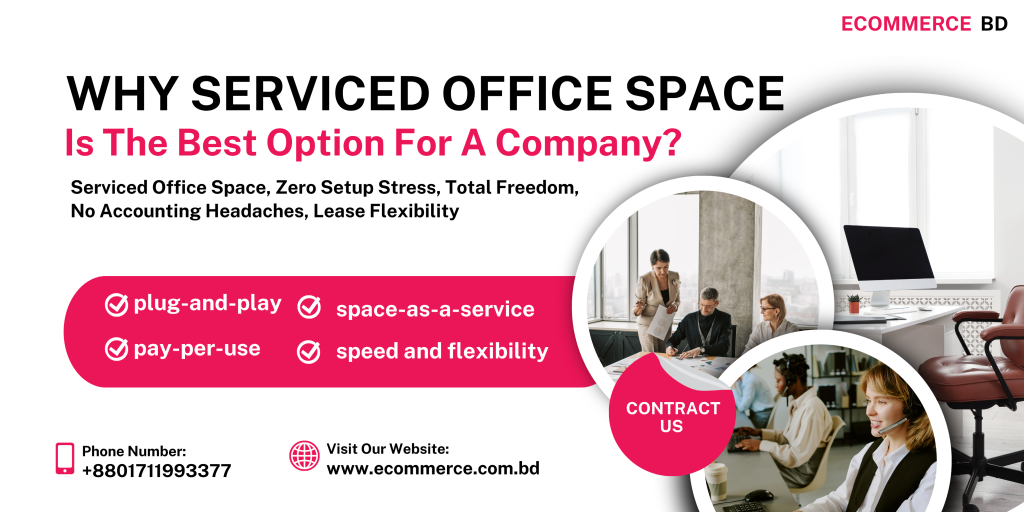
Serviced office space is the best option for a company because it provides a fully furnished, “plug-and-play” environment with flexible terms, removing the headache of office management. Instead of heavy upfront costs, you get private offices and IT infrastructure wrapped into one simple monthly bill.
Beyond just savings, this option offers agility. Unlike rigid traditional leases, you can instantly upgrade or downsize your space as your team changes. This helps you to focus purely on business growth without the burden of long-term contracts or maintenance.
In this blog, we break down everything about serviced workspaces—from all-inclusive fees and cost comparisons to the pros and cons—showing why they are the best fit for your company.
A serviced office is a fully furnished, professionally managed workspace available on flexible, short-term leases. Operators handle all building maintenance and IT infrastructure, helping companies to rent private suites without the long-term financial commitment of a traditional commercial lease.
Essentially, you are renting a “service” rather than just physical square footage. This model enables businesses to move in immediately without dealing with architects, furniture suppliers, or utility providers.
This all-inclusive model simplifies accounting by consolidating operational costs into one single invoice. Your monthly payment typically covers:
Insider Tip:
A quick word of caution from experience: While the rent is all-inclusive, things like booking a boardroom or heavy printing usually cost extra. Make sure you ask exactly how many “meeting room credits” are included per month so you don’t get hit with a surprise bill later.
Why are modern businesses pivoting to serviced offices? Beyond the cost savings, companies choose this model for strategic agility, prime location access, and operational efficiency. It transforms the workspace from a fixed liability into a flexible asset.
Securing an office in a prestigious commercial hub usually requires a massive budget and a long-term commitment. Serviced offices democratize this luxury, helping small and medium businesses to punch above their weight class.
Access to a vibrant community of potential partners.
Isolation kills innovation. Unlike a traditional private office where you are walled off, a serviced workspace places you in a vibrant ecosystem of entrepreneurs, freelancers, and established enterprises.
A turnkey solution for business continuity.
For enterprise-level companies, serviced offices are a crucial component of risk management. They serve as an immediate “Plan B” to ensure business continuity during unforeseen disruptions.
Outsourcing the “invisible work” of facility management.
Time is your most expensive resource. In a serviced office, the “invisible burden” of facility management is completely outsourced, helping leadership to focus on revenue, not repairs.
Enterprise-grade amenities that attract top talent
The quality of your workspace directly impacts your ability to hire and keep top talent. Serviced offices offer a “Silicon Valley” aesthetic that would be prohibitively expensive for a single company to build from scratch.
While this “plug-and-play” all-inclusive model offers unmatched speed and flexibility for growing teams, it often requires trading branding control for convenience. Below is a breakdown of the key advantages and limitations to help you decide.
Rule of Thumb:
If your team is under 10 people or you can’t predict your headcount for next year, the premium cost is worth it for the flexibility. But once you cross 15–20 staff and have a stable forecast, a traditional lease usually becomes the smarter financial move.
Deciding between a serviced and traditional office comes down to agility versus stability. Serviced spaces offer month-to-month flexibility at a premium, while traditional leases provide lower long-term costs and branding control but require significant upfront capital and commitment.
Feature | Serviced Office (The Agile Choice) | Traditional Office (The Stable Choice) |
Lease Flexibility | High: Month-to-month or 1-year terms. You can leave or expand quickly. | Low: Rigid 3–10 year leases. Breaking the lease is difficult and expensive. |
Upfront Cost (CapEx) | Minimal: usually just a 1–2 month deposit. No fit-out costs required. | High: Requires substantial capital for design, fit-out, furniture, and IT infrastructure. |
Monthly Cost (OpEx) | High Premium: Includes rent, rates, utilities, and reception in one fixed bill. | Lower Rent: You pay less per sq. ft. but manage variable bills (utilities, cleaning) separately. |
Speed to Move-in | Instant: Plug-and-play ready. You can move in within 24–48 hours. | Slow: Can take 3–6 months for legal negotiations and office fit-out. |
Office Management | Zero Effort: The provider handles internet, cleaning, and maintenance. | Full Responsibility: You are the facility manager (hiring cleaners, fixing Wi-Fi, etc.). |
Branding & Privacy | Generic: Shared branding and common areas. Harder to build a company culture. | Total Control: You customize the design, layout, and privacy to match your brand identity. |
While a traditional lease offers lower rent, it demands a level of long-term certainty and upfront cash that few businesses have today. The freedom to pivot without penalty is often worth the extra monthly cost, which is exactly why more dynamic companies are now choosing the serviced office route.
Honestly, agility is the main driver here. For startups, it’s a survival tactic—you avoid those high upfront costs and just get to work. But I’m increasingly seeing huge enterprises pivot this way too.
They use these spaces to drop in satellite teams or test new markets without the headache of a build-out. Big or small, nobody wants to be handcuffed to a rigid lease when they can just scale on demand. That is exactly why it’s becoming the top preference for every type of company right now.
Conclusion
Ultimately, serviced offices represent the smartest workspace solution for modern business agility. By combining flexible terms, all-inclusive amenities, and instant scalability, they eliminate the financial risks of traditional leasing.
For companies ranging from lean startups to global enterprises, this “space-as-a-service” model offers the essential freedom to adapt and grow. It is the definitive choice for organizations prioritizing efficiency and operational speed in today’s competitive market.
You should check the fine print for “pay-per-use” services. Common extra charges often include high-volume printing, dedicated bandwidth upgrades, and meeting room usage beyond your allotted credit hours. Always ask for a full rate card for consumables before signing.
This is the main advantage of a serviced office. Most agreements contain a “portability clause” that ensure you to move into a larger unit within the same building immediately, without penalty. You simply adjust the monthly fee to the new rate, avoiding the need to break a lease.
Traditional offices often require 3–6 months of rent as a deposit. Serviced offices only require 1–2 month retainer. This significantly frees up your cash flow, enabling you to invest that capital back into product development rather than locking it away in a landlord’s bank account.
Instead of chasing individual landlords, you can streamline your search with Ecommerce.BD Whether you need a single suite or an enterprise floor, our platform connects you to ensure you get the best terms. Especially in fast-moving markets like Dhaka, where commercial real estate prices fluctuate, this flexibility provides a crucial safety net.